When Gardens Preserve a Sense of Home
Di Rosmarie Hagleitner
What does it mean to cultivate a garden when daily life is shaped by war, migration and economic uncertainty? This question lies at the heart of "My Life Is Compiled of These Little Acts – Garden Stories From Transcarpathia, Ukraine", an exhibition by Ágnes Erőss, an MSCA (Marie-Skłodowska-Curie Actions) Seal of Excellence researcher at the Faculty of Economics and Management, and Anna Tudos, a doctoral student at the Faculty of Design and Art. The project was selected as one of the winners of the Bolzano Art Weeks Open Call and is currently on display at NOI Techpark.
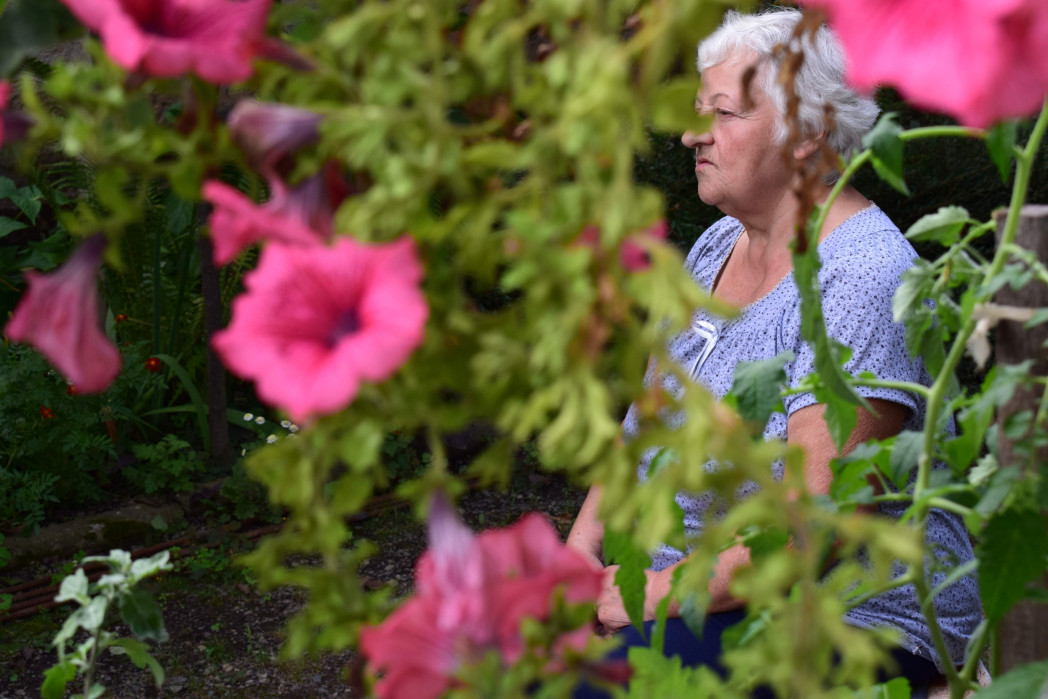
The exhibition focuses on Hungarian ethnic minority women in Transcarpathia, Western Ukraine. Despite the war, many have remained in their villages, tending their gardens even as husbands, sons and neighbours have migrated to Western Europe. Amid unpredictable daily life, difficult economic conditions and the ongoing war, these gardens give structure to everyday life and provide a sense of continuity and moments of relief.
Growing and preserving vegetables is far more than a means of self-sufficiency. Preserved food is often shared with family members living across the border: the jars contain not only the flavours of summer, but also the care of the women who grew, harvested and prepared the vegetables. In this way, gardens become a link between people's place of origin and the places their relatives now call home.
Photographs, interview excerpts, field notes and short films offer insights into the women's everyday lives. The exhibition draws on Erőss's long-term research in Transcarpathia, a region where families' livelihoods have traditionally depended on men working abroad and returning home regularly. Since Russia's full-scale invasion of Ukraine on 24 February 2022, men who wish to avoid conscription no longer return. As a result, the population of villages and rural areas today consists largely of women, children and older men exempt from military service, and women have taken on tasks and responsibilities that were previously carried out by men. FemMinImm explores how these processes reshape the roles of women and men within families and communities.
Erőss has studied migration, immobility, and the intersections of gender and ethnicity in Transcarpathia since 2017. In 2025 and 2026, she continued this research at unibz as part of "FemMinImm", a project awarded the MSCA Seal of Excellence and funded by the Autonomous Province of Bozen-Bolzano. Together with Tudos, she translated the project's findings into the exhibition.
For Erőss, the exhibition is a way of amplifying the voices of the people who made the research possible: the women and men who remain in Ukraine, enduring unpredictability, air strikes, death and the separation of families. It shows how gardens, gardening and caring for one's home become acts of resilience in times of uncertainty and war. The current exhibition gives visibility to these women, convey their emotional attachment to home, and reflect the fragility of their circumstances. "Being selected as a BAW winner means that we were able to translate research results into a story that reaches an audience beyond academia," Erőss says. Documentary filmmaking is another intrinsic part of FemMinImm, allowing her to bring the strength and resilience of these women to a wider, international audience.
On Tuesday, 29 September, Erőss and Tudos will lead a guided tour of the exhibition from 5.30 to 6 p.m. This will be followed by a screening and discussion of two short films, including “The Keepers” by Ágnes Erőss. The documentary explores how gardening, tending animals and caring for the home create a sense of belonging. It shows how this attachment is continually tested as the women reflect on whether—and when—they, too, might have to leave. Through these everyday acts, they preserve a sense of continuity and home amid uncertainty.
A fermentation workshop will also be held on Thursday, 1 October, from 4 to 6.30 p.m. Using locally sourced ingredients from South Tyrol, participants will prepare a traditional Transcarpathian fermented preserve following an original recipe from a Transcarpathian Hungarian village. The programme also includes a guided tour of the International Center on Food Fermentations (ICOFF), based at NOI. The workshop will be held in English, with support available in German and Italian.
The exhibition can be visited at NOI Techpark until Saturday, 3 October, from Monday to Saturday between 9 a.m. and 8 p.m.
Persone nell’articolo: Agnes Eross