“A university as an antenna: bringing the world’s knowledge to South Tyrol”
By Susanne Pitro, Arturo Zilli
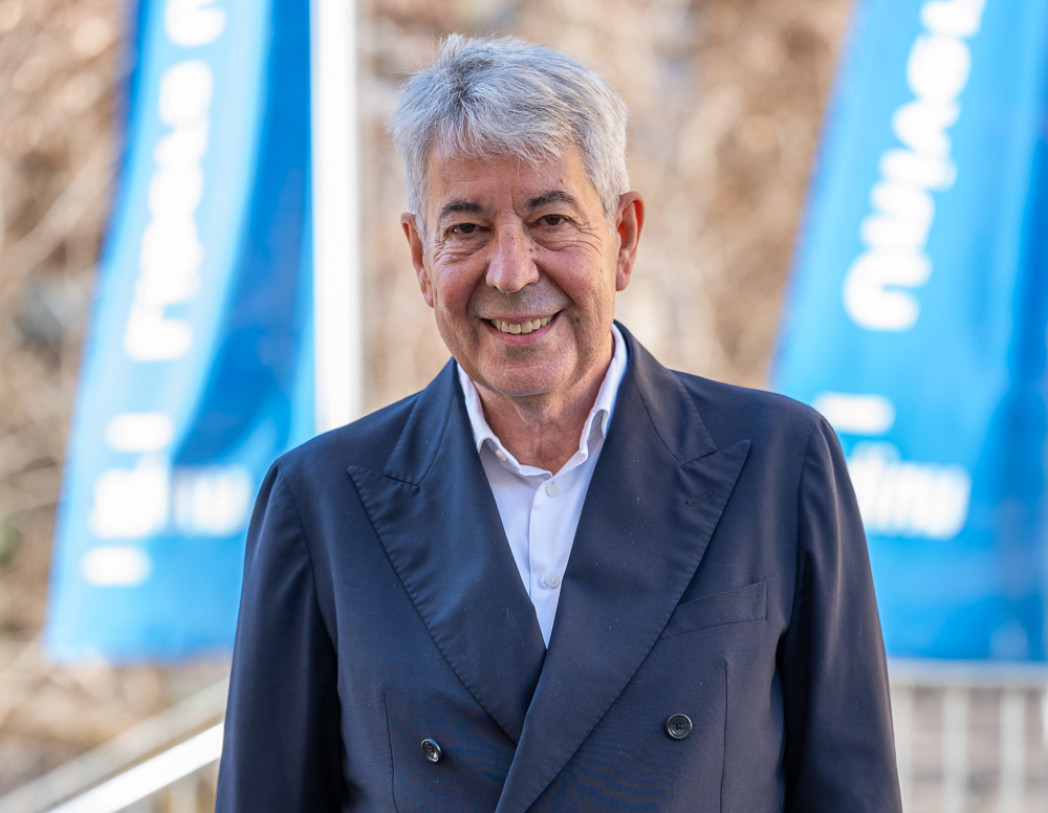
Federico Giudicenadrea, the new president of unibz — and the first entrepreneur to hold the role — has set out the priorities for his term: consolidating the university’s existing strengths, deepening its ties to South Tyrol’s social and economic fabric, reinforcing trilingualism as a defining characteristic, and sharpening its international reach in support of applied research tailored to the Alpine region.
You are the first entrepreneur to lead unibz. What direction do you intend to give the university?
My priority is to consolidate what is already in place. The university has built important relationships with key stakeholders, other research institutions and businesses of different sizes. But I believe we can go further in extending the transfer of knowledge across South Tyrol’s broader socio-economic system — not only industry, but also agriculture, crafts, commerce and tourism. The objective is to ensure that more sectors of society can draw direct benefit from the university’s expertise. I hope I can make a practical contribution to that effort.
As the university approaches its thirtieth anniversary, were you among those in the business community who supported the idea of a South Tyrolean university from the outset?
Yes. In the late 1990s I was already active in the employers’ association and worked to help ensure that South Tyrol would establish its own university. I have followed the development of unibz closely ever since.
Has the university met the business community’s original expectations?
Broadly speaking, yes. In the early years, not every expectation was fully met, but it was always clear that building an institution of this kind would take time. The local economy was also able, to some extent, to help shape that process: for years, the University Council included a representative of the local business community. That helped strengthen the university’s applied and technological dimension in tangible ways. From the perspective of business, the overall assessment is positive.
How would you define unibz today?
It is a university with a clear applied-sciences profile. unibz is not a generalist institution. It is focused on fields closely connected to the realities and needs of the region — Engineering, Agricultural Sciences, Economics, Education, as well as Design and Art, which also has a strongly applied dimension. That is consistent with local priorities. Education, in particular, has strategic importance: the training of primary-school teachers is an essential responsibility for the territory and cannot simply be outsourced. More broadly, investment in that field is an investment in future generations.
You are not only the first entrepreneur to become president of unibz, but also the first Italian. Does that carry any particular meaning for you?
I am sure — or at least I hope — that my appointment was not determined by ethnic background. I am South Tyrolean and, having attended German-language schools, I feel entirely at ease in that language as well. I care deeply about this province because it has given me a great deal and because, as I have said before, it is fertile ground — including for the creation of a company such as Microtec. I have taken on this role not for ethnic reasons, but because I would like to give something back to a place that has given me so much.
As a multilingual South Tyrolean, how do you assess unibz’s trilingual model?
Multilingualism is one of South Tyrol’s defining characteristics. Living at the meeting point of the German-speaking and Italian-speaking worlds makes proficiency in both languages a considerable advantage, both personally and economically. The university can and should strengthen that asset by promoting multilingualism in a meaningful way. It is a distinctive feature that should be preserved and developed further.
Even if, for example in Engineering, language requirements may discourage prospective students from outside the province?
The trilingual model is integral to unibz’s identity. Anyone unwilling to acquire competence in a second or third language can choose a different university. In my own experience, multilingualism is a significant added value and, professionally, a competitive advantage.
How important is the university’s connection to the local area in your vision?
It is fundamental. In the surrounding region there are strong universities, such as Trento and Innsbruck, sometimes with a broader academic scope that extends further beyond applied disciplines. unibz operates in a more specific context. The Alpine region is a complex environment that requires targeted solutions — from engineering and agriculture to organisational and business models. In a multilingual region, education also takes on particular importance. In that sense, unibz can make a substantial contribution to South Tyrol’s economic, cultural and social development.
There is an enduring debate over whether universities should primarily serve their local context or develop an international outlook. Where do you stand?
What is needed is a balance. A purely local perspective is not enough: ideas, knowledge and exchange from outside are essential. I think of the university as a kind of antenna, bringing to South Tyrol knowledge and expertise from around the world. That international dimension is indispensable. At the same time, the centre of gravity of applied research must remain local. International networks and partnerships allow the university to acquire new knowledge and then assess which ideas and solutions can be transferred to, and adapted for, the local context. In other words, local rootedness and global opportunity must be held together. That approach is already visible across much of the university’s work — not only in Engineering, but also in Design, Agricultural Sciences and Economics. The university is engaged with issues closely aligned to regional needs, from production processes and small family business models to innovation trajectories. In that sense, South Tyrol is also a particularly effective laboratory for scientific experimentation.
Why is that?
Because the territory is relatively compact, decision-making can be quicker, and the economy is characterised by a strong base of small and medium-sized businesses, which are generally more flexible. That makes it easier to introduce, test and refine new technologies and solutions. It is also embedded in the local economic culture: many South Tyrolean companies are deeply rooted in the region while operating successfully in international markets.
What do you see as the priorities for your four-year term?
First of all, I want to deepen my understanding of all the university’s internal realities. Engineering is a young faculty with considerable potential and will need to define and consolidate its mission clearly. Agricultural Sciences appears more mature and strongly anchored in the local context; the same applies to Economics and Education, and to Design and Art. Education is an area I know less well, and one I intend to follow particularly closely.
What, in essence, is the broader strategy you are proposing?
For a relatively small university, the most effective strategy is to pursue excellence in a clearly defined set of specialist areas. South Tyrol offers important niches: the Alpine environment, distinctive production systems, business models and multilingualism. If the university can build distinctive expertise and genuine excellence in those fields, it can be recognisable and competitive well beyond the province itself.
A university also involves bureaucracy and organisational complexity. How do you approach that aspect of the role?
That is true: the bureaucratic dimension is more pronounced. Even so, I see several parallels with running a business. In organisations of several hundred people, complexity increases and communication becomes more difficult; layers emerge, as do groups and internal dynamics. Ensuring coherence and alignment requires strategic vision and the ability to manage processes effectively. I hope my experience will be useful in handling the challenges that come with unibz’s growth.
With your entrepreneurial background, do you think you can steer those dynamics effectively?
I do not have a magic wand, and I am well aware that there are no simple or immediate solutions. But I am used to dealing with organisational and growth-related challenges, and I believe that experience can make a constructive contribution.
Related people: Federico Giudiceandrea